






CONCERNS ANSWERED
Here I anticipate and answer some likely criticisms of the tax system proposed at this site.
For proposal, see Proposed Reform. For more on justifications, see Tax Reform Essay.
ETHICS AND FAIRNESS

Some will say a net-worth tax is a confiscatory tax (Wrong!) - that the government is seizing a portion of your property. Yes, your governments would require payment of a tiny portion of the wealth from those rich enough to pay. Every tax is confiscation, a required payment from your wealth. For income taxes, your earnings are generally withheld (confiscated!) before you ever see them. For sales and property taxes, the tax is taken (seized!) from your accumulated wealth, just like the proposed net-worth tax. The alternative to our governments requiring tax payments is, for starters, closing our schools, letting our bridges fall into the rivers they cross, discharging all of our soldiers, ending veterans' benefits, and stopping all Social Security and Medicare payments.
Some will say a net-worth tax is "double taxation" since the money the wealthy have accumulated has already been taxed as income (Wrong!). Firstly, much of this wealth is from unrealized capital gains that has never been taxed, or it is from qualified dividends and long-term capital gains that were undertaxed (at roughly 4-fold lower total federal tax rates) compared to work. Secondly, under the current system, nearly all money used to pay sales, excise, and property taxes has already been taxed as income. They, more than a net-worth (wealth) tax, represent double taxation and are regressive taxes to boot. Most of them should be done away with, certainly before dismissing a wealth tax as double taxation.
Taxing the wealth (net worth) of the most wealthy will increase their taxes. Some will say: "But the top 5% already pays 60% of the taxes." (Wrong!) Firstly, the top 5% owns 65% of the wealth (net worth) in this country. It seems that they are under-taxed if they pay only 60% of the taxes while 15% of the nation lives in poverty.
However, secondly, the sound-bite is wrong. The correct statistic is: The top 5% of households in terms of federal adjusted gross income pay 60% of the federal income tax. That is, the sound-bite refers only to federal income tax on federally taxable income. The federal income tax accounts for about 30% of all taxes collected from individuals in the United States. Our other taxes, like payroll taxes, sales taxes, excise taxes, and property taxes, shift the total tax burden from the wealthy investing class to the working middle-class. The non-misleading telling statistic is: THE TOP 5%, WHO HOLD 65% OF THE NATION’S WEALTH, PAY ONLY 35% OF ALL TAXES PAID IN THE USA EACH YEAR.
Thirdly, the argument that "because the very wealthy pay more than half of all federal income taxes means they are paying enough" is simply not a valid argument. Under that logic (in a 20-person economy), it would be fair to charge each of the 19 bank tellers a 100% tax on their $15,000 yearly salaries and charge the bank president a 4% tax on his $10,000,000 salary ... because, after all, the top 5% (the bank president) would be paying about 60% of all taxes.

In addition, the very wealthy, to a much greater extent than the middle class and poor, can take advantage of nontaxable compensation, adjustments to taxable income, more tax savings for each deduction, reduced tax-rates on some investment gains, no tax on other investment gains (such as unrealized capital gains, which are the largest source of wealth in the US), and tax-exempt accounts to avoid taxation on their actual income. The non-partisan Congressional Research Service found that 200,000 millionaires — almost two-thirds of taxpayers with taxable income above $1 million — paid a lower tax rate (combining income and payroll taxes) than the typical taxpayer making less than $100,000. This and the fact that accumulated wealth is ignored in the determination of taxes results in the wealthy shouldering far less than their fair share.

Reducing taxes on the middle class? We also often hear that, "half of American households pay no taxes." (Wrong!) This sound-bite is simply wrong. About half of households pay no federal income taxes, but federal income taxes amount only 30% of the taxes paid in this country. There is probably no non-institutionalized adult in the USA who truly pays no taxes - no Social Security taxes, no sales taxes, no property taxes, no gas taxes. Consider all the taxes paid by a single home health aide earning minimum wage for full-time work, $14,500 per year. She pays over $2500 in total direct taxes plus about $2800 in indirect taxes, in all 37% of her wages. Her direct taxes include $600 in federal income taxes and $1100 in direct federal payroll taxes ... and no, she would not qualify for the earned income tax credit or for food stamps. A widow living on Social Security benefits can easily pay 30% of her income on property and other taxes. [Both pay about 3 times the rate paid by Warren Buffett on his investment gains.] The group paying no federal income taxes consists of mostly the elderly and disabled living on Social Security, those laid off in the current recession, students with part-time work, and large families earning very low wages. All of these groups pay other taxes, often exceeding their fair share compared to 1) their ability to pay and 2) their wealth derived from economic infrastructure provided by governments. The Fair Share Tax Reform proposed here sets things right by considering all taxes and the two best measures of ability to pay and government-derived prosperity: income and wealth (net worth).
Three-quarters of all capital gains, taxed at only 15%, go to the top 1% of income earners (Krugman 2012). In fact the top tax rate now for most taxable investment gains is 15%. This explains why the top 400 taxpayers in the US now pay an average federal tax rate of 17% on their reportable income. On top of that, most investment gains are not reportable as income and so not taxed at all. On top of that, here are no social security (payroll) taxes on any investment income or gains, while workers pay 7.7% of their wages in payroll taxes in addition to any income taxes. (Most economists say the real rate of payroll taxes is about 15%, since employers reduce workers' wages to pay the employer share of the payroll tax.)
Some will argue that "wealthy investors put their money at risk and so that should qualify them for Investor welfare in the form of favored tax rates" with their capital gains and dividends taxed at about one-third the rate paid by workers on their wages. (They are dead wrong since they ignore the following) Workers give away their time, about half of the waking hours in their lives. They don't just put those hours at risk - they will definitely lose those hours for all time, and those hours are much more valuable to them than say Mr. Buffett's money is to him. In addition, many workers - coal miners, police, folks in stressful jobs - put the remainder of their lives at risk every day. Shouldn't workers, certainly contributing the hours of their lives and often risking an early death, get at least the same tax rates as those that are only putting money at risk?
THE ECONOMY


Under the Fair Share Tax Reform proposed here, the working poor and middle class would be taxed less and so will have more money to spend and invest, which will stimulate the economy. Well-funded governments will be able to make the investments in education, research, and infrastructure, which will make the economy more efficient, and cut deficit spending, which will free up capital for the private sector. As detailed in the Essay, ending favored tax treatment for investment (and the wealth concentration it leads to) will reduce investment bubbles and the recessions they trigger. The resulting strong, efficient economy will benefit rich as well as the poor. The poor and middle-class will invest more as their taxes decrease and tax-free education-retirement accounts are encouraged. The rich who stay invested under the reformed tax system will likely earn more from the economic effects of the reform than they will pay in additional taxes. Academics studies show that reduced economic inequality, within reason, promotes economic growth (link). History supports this:

In 1993 under President Clinton, taxes on upper incomes were increased. Many Republican congressmen predicted this would lead to a recession, "kill jobs," and so increase the federal deficit. (sound familiar?) There are many influences on the economy. That said, this tax increase on the rich was followed by:
-
•Our longest peacetime economic expansion (avg. GDP growth 3.6% 1993-00)
-
•the creation of 23 million new jobs in eight years,
-
•an increase in the median household income by $6000 over eight years,
-
•federal spending cuts of 3.2% of GDP (tax increases do not increase spending)
-
•high tax revenue, elimination of federal deficit, the first surpluses in 40 years,
-
•and low inflation.

-
•a choppy economy (average annual GDP growth 1.6% 2001-09, < half Clinton's),
-
•only 3 million new jobs (1/8th of Clinton & the lowest rate last 11 presidents)
-
•widening economic disparity between poor and rich,
-
•a decrease in the median household income by $1000 over 8 years,
-
•federal spending increase of 2.4% of GDP (tax cuts do not decrease spending)
-
•a large drop in tax revenue with doubling of the national debt,
-
•and the worst economic crisis since the Great Depression of the 1930's.
Even Bruce Bartlett, who worked for Presidents Reagan and Bush 41 agrees with the above analysis (link). He also finds that among developed nations, Germany, Austria, Sweden, Finland, Denmark, the Netherlands, Norway, Iceland, Britain, Japan, and Canada have higher employment rates, despite having total federal tax rates of up to 50%. The US’s rate is 30%. Ireland, South Korea, Israel, and Mexico have total federal tax rates lower than ours ... and lower employment rate than we have (link).
In the 18 years before the special tax rates for investment gains went into effect the inflation-adjusted annualized return on the S&P 500 was 8.8%. Since those favored tax rates for the wealthy went into effect the inflation-adjusted annualized return on the S&P 500 (1998 to mid-2011) dropped to 1.6%. That is, the historic typical return on stocks dropped to one-fifth of what it used to be. This hurt the wealthy much more than the tax cuts helped them. It also hurts the middle class, which has much of its retirement savings in the stock market.
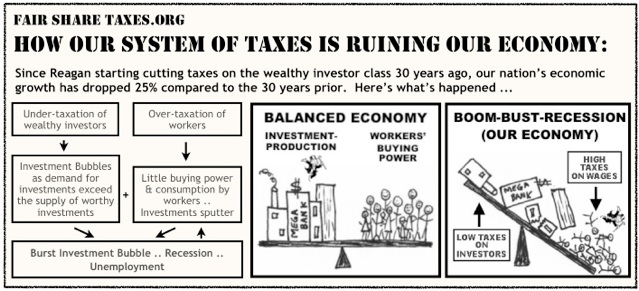
Extending the analysis over the past roughly 60 years produces the same association between more progressive taxation and improved economic growth. From 1950 to 1980, America’s highest marginal tax rate ranged between 69% and 92%, and the nation’s inflation-adjusted average annual economic growth (real GDP growth) was 6.4%. Real GDP growth is the best measure of an economy's strength. During 1980 to 2010, after President Reagen took office and started cutting the top rate so it ranged ranged between 28% and 50%, the economy grew at an average annual rate of just 4.1%. Thus, average annual GDP growth was 55% higher (6.4 vs 4.1%) when tax rates on the most wealthy were higher. [If we take out the Clinton years of somewhat higher taxes on the wealthy from last 30 years, average real GDP growth was 2.7%, less than half the rate of economic growth of the 30 years prior to Reagan]
What if we compare the incomes of Americans in the periods before and after tax cuts for the wealthy started under Reagan? For typical American, the bottom 90% average inflation-adjusted income increased $13,000 or 75% during the 30 years before Reagan started cutting taxes on the wealthy. In the 30 years after Reagan, they went up $600 or 2%. During that same period of ever more tax cuts for the rich, the average income of the top 1% tripled (increased about 200%) or about $1,000,000. There was no trickle down.
It is not coincidental that the Great Depression was triggered by the US stock market crash just after the last time our wealth disparity reached the levels reached in 2007. The Great Depression followed the real estate and stock market bubble - of the Roaring Twenties - which was caused by the massive Republican tax cuts (from 73% to 25%) for the wealthiest and the top 1% gaining 40% of the nation’s wealth. Sound familiar? That is exactly the scenario that led to our recent financial meltdown. Thus it is clear that reasonable tax rates on the wealthy do not hurt the economy. History supports the opposite conclusion.


Some wills say "We have the best economy in the world, so don't tinker with it. Favored tax rates for the wealthy encourage people to become wealthy, fueling our great social mobility. (Wrong!)" In a study of the 18 developed economies (The US, Canada, European countries, Australia, New Zealand, Japan, and South Korea), the United States was dead last in economic equality, overall poverty rates, and childhood poverty rates. We were 5th last (of the 18 countries) in senior poverty and health-care quality (link). Social mobility in the United States is a myth. Among boys raised in the bottom one-fifth here, 42% stay there as adults. The numbers for Denmark and Britain, for instance, are better, between 25% and 30% (link).
PRACTICAL CONSIDERATIONS


Some will exclaim, "the proposed tax system is taking away your home-interest deduction, your charitable contribution deduction, your property tax deduction, etc., all used by the middle class. (Because so many families claim the standard deduction, the mortgage interest deduction saves a typical middle-income households about $200 a year. The average family in the top 1 percent saves more than $5,000 from the mortgage deduction.) "Your gasoline tax will increase!" "Your tax free accounts will be capped!" (All Misleading!) None of this matters. The important information is on the bottom line: the total amount of taxes each household pays each year. Under the proposed tax system, everyone in the middle class will pay less total taxes than they do now. Only the wealthiest 5% or so will pay significantly higher taxes, finally their fair share.
Some may initially think, if my net-worth is taxed at 2% (combined federal-state-municipal because I have a $2.5 million fortune), "in 50 years all of my wealth will be gone." (Wrong!) Of course, anyone with that sort of wealth generally earns an average 8-10% rate of return on it annually. Assuming a 9% annual investment return and the proposed wealth tax indexed for inflation: after only 10 years (without working to add a single penny), the $3 million would have grown to nearly $5.8 million ($4.5 million adjusted for inflation). After 50 years, the 3 million family fortune would have grown to over $50 million despite the proposed wealth tax. Remember under the proposal, capital gains taxes, corporate taxes, and estate taxes are eliminated.

One way to view the 3% net-worth tax (combined federal, state, and municipal) that would be paid by those with a net-worth of over about $45 million is by dividing the 3.0% by 3 as follows: 1.0% would replace current capital gains taxes for the federal government (a 20% tax on presumed very conservative average 7% investment capital gains on 70% of assets - This seems more than fair since middle class workers have for years paid 25-40% of their wages from work in total taxes.); 1.0% would replace about the current 30% estate tax on a fortune (just taken out in small annual chunks rather than breaking up the "family farm" on the death of a multi-millionaire); 1.0% would represent a very mild claw-back for all the unrealized capital gains that have never been taxed; and is further justified because net-worth is the best measure of the extent to which a household has profited from the economic infrastructure that government (other taxpayers) provide. Two-thirds of all "entitlements" currently go to households well above the poverty line. Shouldn't they be paying for it?
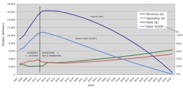
Some will say, all we need to do is reduce government spending (wrong) rather than increasing revenue as your plan does. Our government has the lowest taxes as a percent of the economy of any developed country. The Fair Share Tax Reform Plan increases federal revenue by 10%, back to where they were, as a percent of GDP, under the Clinton Administration. Anything less simply will not pay for the government programs we need. 91% of all so-called "entitlements" go to people who are employed, disabled, or seniors. Surely defense spending can be reduced and health care spending needs to be reformed. The spending reforms proposed here cut $2 of spending for every $1 increase in taxes proposed under the Fair Share Tax plan.

TYPES OF TAXES AND IMPLEMENTATION

Some advocate supplementing or even replacing our income tax with a sales tax (or a similar "value-added tax") (Bad idea!). Two Republican Congressmen have repeatedly proposed replacing the federal income, payroll, and estate taxes with a 30% national sales tax and dubbed it the "Fair Tax." Since the poor and middle class spend much more of their income and wealth than the wealthy do, under such a tax the wealthy would pay even less of their fair share than they are paying under the current regressive system. For instance Warren Buffett's taxes would drop from 11% to about 0.04% of his investment income and gains. See VAT Criticism. Income and wealth (net worth) are the best measures of households' ability to contribute to the cost of government services and so should be the basis for taxation.



POLITICAL PHILOSOPHY


Some will criticize this tax reform proposal a "redistribution of wealth" (Wrong!) or a call for "class warfare." [First let us agree to drop second term. In warfare, courageous men and women risk and give their lives for their country and the well-being of their fellow-citizens. It seems disrespectful to soldiers, veterans and those disabled or killed in combat to use this term for what amounts to an argument over money.] The fact is there has always been a fight over the distribution of the a society's wealth and that all taxes redistribute wealth. It is an undeniable fact that over the last 30 years in this country wealth has been redistributed - from the middle class to the wealthy - and the tax system has contributed to this.
CRITICAL PAGES: HOME ROMNEY TAXES SUMMARY IMAGINE! HELP US!.
SEE FULL NAVIGATION MENU BENEATH PHOTOS AT TOP OF PAGE
COPYRIGHT - FAIR SHARE TAXES - ALL RIGHTS RESERVED
FAIR SHARE TAX REFORM - A comprehensive tax reform plan for federal, state and local governments, that reduces total taxes on the working-poor and middle-class by thousands each year, encourages stable economic growth, vastly simplifies our tax laws, and slashes the national debt.
CONTACT ME: fairsharetaxes@att.net