Download a copy of the FairShareTax Summary.pdf to email, mail or fax to friends, the media and politicians



CRITICAL PAGES: HOME ROMNEY TAXES SUMMARY IMAGINE! HELP US!.
FUNDAMENTAL TAX REFORM
FairShareTaxes.org ... The Open-Source Tax Reform Proposal
Powered by three years of suggestions by Americans ... Contact me at fairsharetaxes@att.net
Those who go to work every day, those who work hard at raising their children, those who fight for this nation. These men and women - much much more than any bank executive or congressman - have made our country great and a force for good in the world. Over the past thirty years, the way of life of these working-poor and middle-class men and women has been under attack by a group of avaricious financial elites, aided by those politicians willing to do their bidding. The undoing of the common American citizen, hard-working and courageous, is weakening our nation, to the detriment of everyone, rich and poor, here and abroad.
The bottom 50% of households in the United States now owns only 1% of the nation's wealth, while the wealthiest 1% of households owns nearly 40% of the nation's wealth (up from 25% thirty years ago). Economic modeling indicates that our regressive tax system accounts for most of this dangerous economic inequity.
Our System of Taxation: Effective tax rates, as they are generally reported, are flawed in two ways. Firstly, they often refer only to the federal income tax, which represents only 30% of the taxes collected in the United States. When the other taxes - Social Security taxes, state taxes, sales taxes, property taxes, indirect corporate taxes - are added (to the numerator), the tax rates of the working-poor & middle-class can increase five-fold or more. Secondly, wealthy investors need never report any gains in their large tax-free accounts or any unrealized capital gains. Adding that income (to the denominator), makes their actual overall tax rates much lower than generally reported. In the calculations below, these two flaws are eliminated.
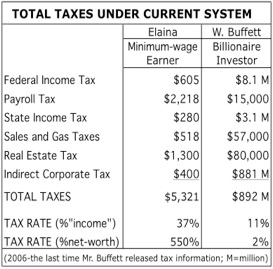
Suspicious of the tax calculations that include indirect taxes? Then consider direct taxes only: Mr. Buffet paid direct taxes that were much less than 1% of his $8 billion investment gain. (Mr. Buffett acknowledges and opposes the favored tax treatment that he and other wealthy people enjoy.)
Looking at total taxes as a percentage of accumulated wealth, rather than income, Mr. Buffett paid 2% of his net worth in taxes, while the minimum-wage worker paid 550% of her net worth. For detailed calculations, including those of a middle-class family & a millionaire couple, see "Four Taxpayers" page, FairShareTaxes.org
Our System of Taxation Weakens Our Nation: Clearly the system of taxes in the United States is grossly inequitable. When our multiple taxes are totaled and compared to all types of income, including investment gains, the total taxes are neither commensurate with ability to pay nor the degree to which the wealthy have benefited from the economic infrastructure that our governments - that is, all taxpayers - provide. In addition, the current tax system harms the nation in all the following ways:
-
• It contributes to the vicious cycle that concentrates wealth and political power in a very small investing class, threatening our democracy.
-
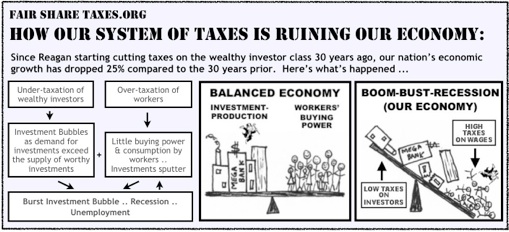
• It distorts relative incentives and the “free market,” favoring private investment gains over work wages and private consumption, leading to too many investment dollars chasing too few worthy investments ... market forces overwhelm any financial regulations ... investment bubbles in the setting of reduced consumption ... repeated recessions ... financial hardship for all but the wealthiest and stagnant economic growth, threatening our survival as a nation. (See box)
-
• It leads to marked economic inequality, which studies have associated with (at all socio-economic levels) worse health and mental health, higher infant mortality, lower life expectancy, increased substance abuse and incarceration rates, reduced innovation, reduced societal trust, and other societal ills. The United States is falling behind the rest of the developed world in all these measures of a decent life.
-
• It impedes social mobility, which reduces the motivation to work hard and reduces the likelihood that each person has the means to reach their full potential. This, in turn, hobbles the economy, weakens the nation, and impedes progress toward a better world.
-
• It fails to compensate for price distortions, and so activities that have a high cost to society, government, and so all taxpayers do not have those costs reflected in the price paid by consumers (e.g. fossil fuel use, cigarette smoking, unhealthy foods, refusal to buy health care insurance).
-
• It underfunds governments, leading to neglect of national priorities that would improve and save lives and ensure prosperity for future generations (e.g. education, health-care, environmental protection, basic research, economic infrastructure, international aid).
-
• It underfunds governments, leading to a ballooning of the national debt, which enriches competing nations at the expense of current and future taxpayers and reduces credit available to the private sector.
-
• It is complex, expensive, opaque, and difficult to administer and comply with, costing taxpayers billions of man-hours and hundreds of billions of dollars annually simply to file tax returns. Many of the taxes individuals ultimately pay are hidden as indirect taxes (e.g. Economists agree corporate taxes are ultimately paid by workers and consumers as well as investor-owners.)
Fundamental Tax Reform: If taxes are to be made commensurate with the extent to which a household has profited from the services government provides, then net worth - as well as income - must be taxed. Below is a first-pass effort to design a fair, simple tax system that mitigates each of the problems outlined above. (For technical details, tax formulas, tax forms, revenue generated, etc., see Tax Details, Tax Form, Spending and Debt pages at FairShareTaxes.org) Under the Fair Share Tax Reform there are no deductions, and all regressive, inefficient, and hidden indirect taxes are eliminated. All federal, state, and municipal government services and programs would be paid for entirely with the combination of:
-
•A reformed, vastly simplified Federal Income Tax with a 20% rate on all income and other compensation, excluding only the following, which are taxed at 3%: 1) income below realistic poverty line (e.g. the first $30,000 for a family of three), 2) medical expenditures exceeding 6% of income, and 3) income placed in or spent from modest tax-free education-retirement accounts (automatic with opt-out). That is, only income needed to “get by” is taxed at a reduced rate, producing a logical, justifiable, moderately progressive tax. For typical families of three, the effective federal income tax rate would be 3% on an income of $20,000, 10% on $65,000, 15% on $160,000, and 20% on $20 million or more. Instead of the corporate tax, corporations and businesses are required to distribute 70-95% of actual profits as dividends, which are taxed at the same rate as other income. Social Security and Medicare Taxes are eliminated, and the programs’ benefits are paid out of general revenue.
-
• A new Federal Net-worth Tax of 2% on net worths excluding the first $800,000 for typical families, so that the effective federal tax rates would range from 0.4% ($4000 tax) on net worth of about $1 million up to 2% on net worths of $40 million or more. This tax replaces current property, capital gains, and estate taxes. The wealthiest roughly 12% of households would be subject to this Net-worth Tax.
-
• A 6% War Tax surcharge on the Federal Income and Net-worth Taxes (a $10,000 tax bill increases to $10,600) during any year the nation is at war and two years thereafter, so everyone contributes to any war effort and the subsequent care of our veterans.
-
• Funding of state and municipal governments through a surcharge on each household’s combined Federal Income and Net-worth Tax, with the surcharge rate set by each state and municipality. The average surcharge for state and local government would total 50% of a household’s federal tax bill at first but likely decline over the years.
-
• Retaining and increasing excise taxes only on activities that have a hidden cost and that society would like discourage, such as fossil fuel purchases and failure to purchase health insurance. These would account for less than 10% of taxes collected. Therefore, for poor and middle-class households, the excise taxes would be much more than offset by the reduction in their other taxes. [For activities that society would like to promote, such as education and saving for retirement, a single unified tax-free account with a modest cap is established for all working adults unless they opt out. Thus workers also become investors: Job doers also become job creators.]
-
• Eliminate all current payroll (Social Security, Medicare), capital gains, sales, property, estate, and corporate taxes, as they are replaced by the above taxes.
Under the proposed Fair Share Tax Reform, about 80% of taxpayers would have their total taxes reduced substantially: A minimum-wage worker’s total tax rate (combined federal, state, and municipal) drops from about 35% to 7% of her wages. A typical working, middle-class family’s total tax rate drops from about 35% to 20% of their income, a savings of over $12,000. Warren Buffett’s total taxes would increase from 11% to 34% of his income and investment gains. 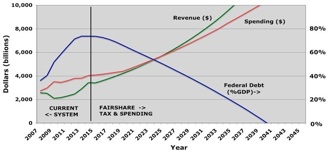
The Fair Share Tax Reform would increase federal revenue by 10%, allowing for the increased investment in education, research and infrastructure needed to ensure future economic growth. If every $1 of increased tax revenue is matched with $2 of decreased spending (primarily by reining in the current unrestrained transfer of taxpayer dollars to the medical and defense industries), the reform would produce federal surpluses within 10 years, and would pay off the entire national debt within about 25 years. (graph right and Spending & Debt pages at FairShareTaxes.org)
Under the Fair Share Tax Reform all tax returns would be reduced to one or two pages. The calculation becomes so simple that each tax filer could easily see that everyone is playing by the same rules. Investment in production would come into balance with workers’ buying power. The economy and our democracy would flourish, to the benefit of everyone: poor, middle-class, and wealthy alike.
Peter Gloor
Branford, Connecticut
CRITICAL PAGES: HOME ROMNEY TAXES SUMMARY IMAGINE! HELP US!.
SEE FULL NAVIGATION MENU AT TOP OF PAGE
COPYRIGHT - FAIR SHARE TAXES - ALL RIGHTS RESERVED
FAIR SHARE TAX REFORM - A comprehensive tax reform plan for federal, state and local governments, that reduces total taxes on the working-poor and middle-class by thousands each year, encourages stable economic growth, vastly simplifies our tax laws, and slashes the national debt.
CONTACT ME: fairsharetaxes@att.net